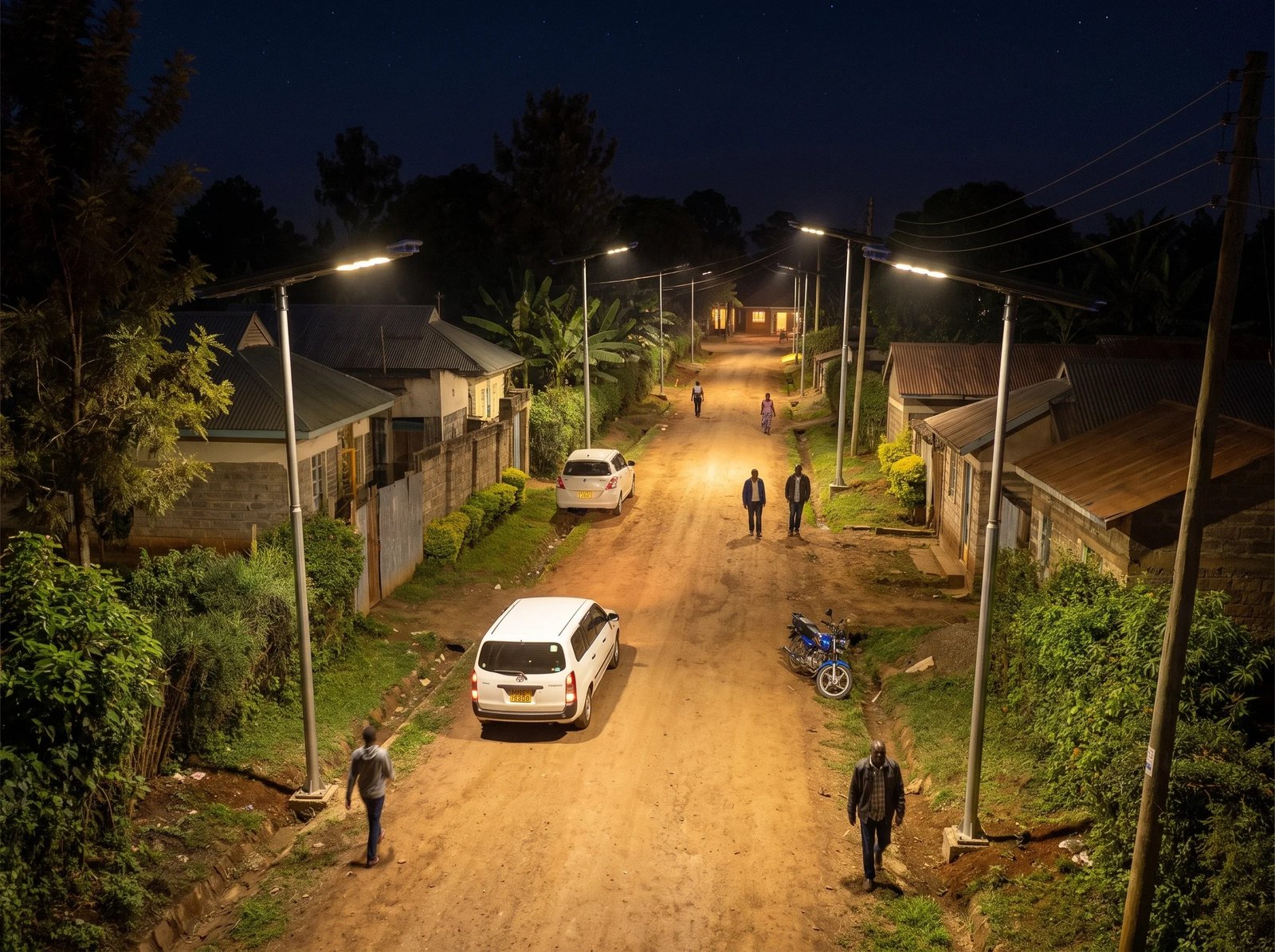
When a city, developer or contractor decides to go solar for street lighting, the first big technical choice usually comes down to two system designs: all-in-one and split type. Both use the same basic parts, a solar panel, a lithium battery, an LED light source and a controller. The difference is how those parts are packaged and mounted, and that difference has real consequences for cost, performance, installation and maintenance.
This guide explains how each design works, where each one performs best, and how to decide which is right for your road project.
What Is an All-in-One Solar Street Light?
An all-in-one solar street light combines the panel, battery, LED module and controller in a single compact housing. The panel sits on top of the fixture, the battery is built into the body, and the whole unit mounts on the pole with one bracket.
Because everything comes pre-assembled and pre-wired, installation is fast. A crew can mount the unit, switch it on and move to the next pole in minutes. There is no separate battery box, no cabling down the pole and no panel bracket to align.
Modern all-in-one solar street lights have come a long way from the small, low-output models of a decade ago. With high-efficiency monocrystalline panels, LiFePO4 batteries and smart dimming controllers, they now cover many residential streets, parking areas, campuses, village roads and secondary urban roads.
Advantages of All-in-One Systems
- Fast installation with minimal wiring and fewer installation errors.
- Lower shipping and handling cost because each unit is compact.
- Clean appearance with no separate panel or battery box on the pole.
- Theft resistance because the battery is sealed inside the fixture at height.
- Simple maintenance since the whole unit can be swapped if needed.
Limitations of All-in-One Systems
- Panel size is limited by the size of the fixture, which caps how much energy can be harvested.
- Panel angle is fixed to the fixture, so it cannot always face the sun at the ideal tilt.
- Heat exposure: the battery sits directly under the panel, which matters in very hot climates unless the design manages heat well.
What Is a Split Type Solar Street Light?
A split type system separates the components. The solar panel is mounted on its own bracket at the top of the pole, the LED luminaire is mounted on an arm, and the battery is housed separately, either in a box on the pole, at the pole top, or buried in the ground at the base.
This separation gives designers much more freedom. The panel can be as large as the project needs and can be tilted and oriented for the best solar gain. The battery can be sized generously for long autonomy. The luminaire can be chosen purely for its optics and output.
That is why split type solar street lights are often specified for highways, arterial roads, wide urban streets and sites at higher latitudes or with long rainy seasons.
Advantages of Split Type Systems
- Higher output for wide roads and taller poles.
- Larger, adjustable panels for better energy harvest in low-irradiation regions.
- Longer autonomy through bigger battery banks.
- Better battery protection from heat, especially with shaded or underground placement.
- Flexibility to replace or upgrade individual components.
Limitations of Split Type Systems
- More installation work: more brackets, cabling and alignment.
- Higher component and shipping cost per pole.
- Theft risk if battery boxes are placed low on the pole without protection.
Side-by-Side Comparison
| Factor | All-in-One | Split Type |
|---|---|---|
| Typical roads | Residential, village, parking, campus, secondary roads | Highways, arterial roads, wide urban streets |
| Typical pole height | 4 to 9 meters | 8 to 12 meters and above |
| Installation time | Very fast | Moderate |
| Panel size and angle | Limited, fixed | Flexible, adjustable |
| Autonomy | Good, depends on climate | High, easy to extend |
| Upfront cost per pole | Lower | Higher |
| Best climate fit | High-irradiation regions | All regions, including cloudy and high latitude |
How to Decide: Five Practical Questions
1. What road class are you lighting?
The road class sets the required light level and uniformity. Residential and low-traffic roads are usually well served by all-in-one systems. Major roads with higher lighting classes often need the output and panel area that split systems provide.
2. How much sun does the site get in the worst month?
Design for the darkest month, not the yearly average. In regions with strong sun all year, an all-in-one system can comfortably meet the load. In regions with long monsoons or short winter days, a split system’s larger panel and battery give a safer margin.
3. How many cloudy nights must the system survive?
Many tenders require two to five days of autonomy. The longer the requirement, the more likely a split system becomes the practical choice.
4. What are the installation conditions?
Remote sites with limited equipment and crews often favor all-in-one units because they are faster and simpler to install. Large highway projects with proper equipment can handle split systems without difficulty.
5. What is the security situation?
Where battery theft is a concern, all-in-one units, or split systems with pole-top or buried batteries, reduce the risk.
Do Not Skip the Lighting Calculation
Whichever design you choose, the right answer comes from a lighting calculation for your actual road, not from a product catalogue. A proper design in a tool such as DIALux shows whether the chosen system meets the required luminance and uniformity at the proposed pole spacing and height. It often reveals that a mix of both designs is the best solution: split systems on the main road, all-in-one units on side streets and parking areas.
It also pays to work with a manufacturer that offers both designs and can size each one honestly for the site. Engineering-led manufacturers, for example those with German-engineered design and testing processes, will usually recommend the system that fits the road rather than the one that is easiest to sell.
Final Thoughts
All-in-one and split type solar street lights are not rivals so much as tools for different jobs. All-in-one systems win on simplicity, speed and cost for residential and secondary roads in sunny regions. Split type systems win on output, flexibility and autonomy for major roads and challenging climates. Start with the road class, the worst-month sunlight and the autonomy requirement, back the decision with a lighting calculation, and the right choice usually becomes clear.