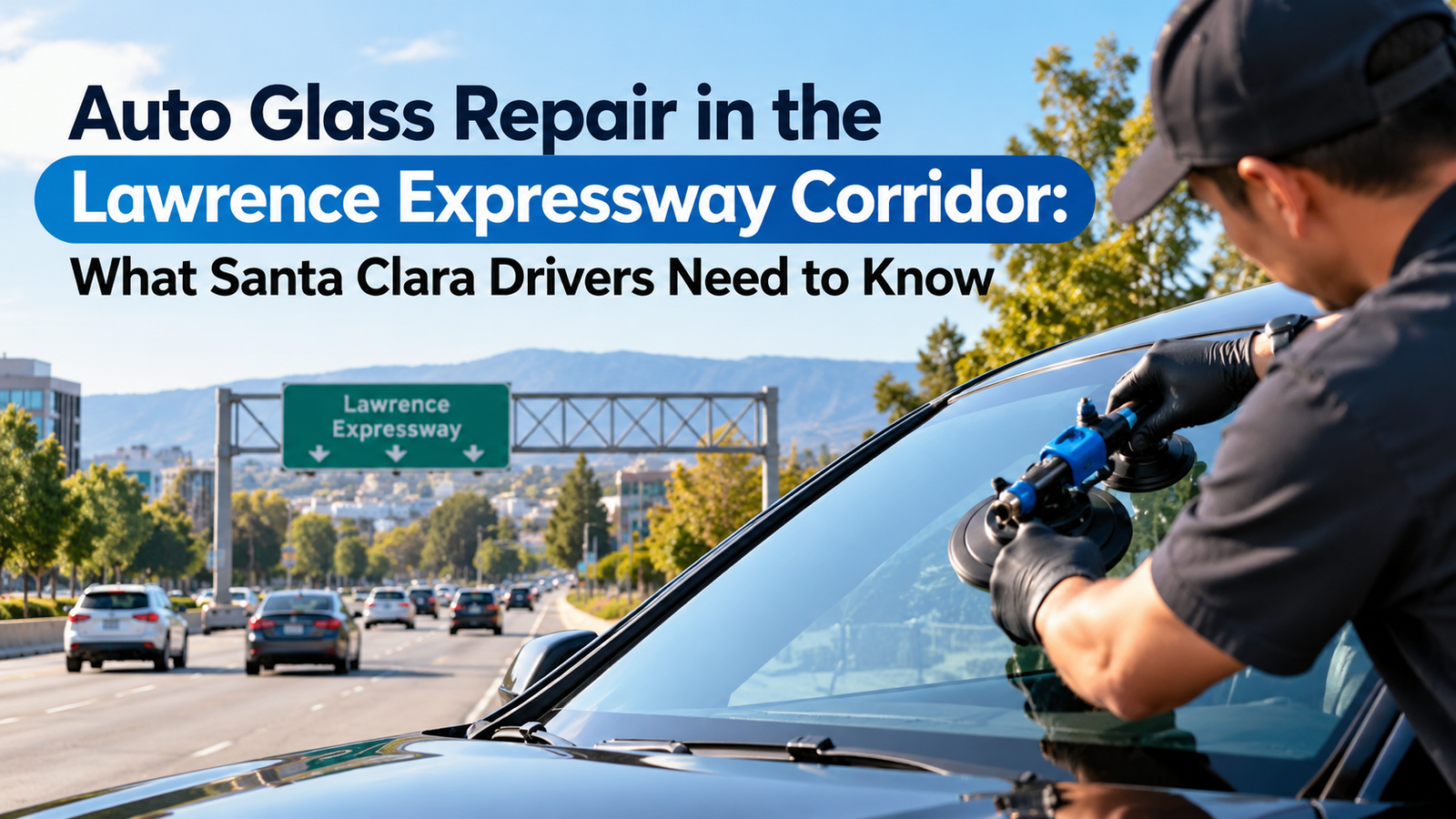
Lawrence Expressway the county expressway that runs roughly 16 miles from San Jose in the south to Sunnyvale and the US-101 junction in the north, passing through the heart of Santa Clara County’s technology corridor is one of the most heavily traveled roads in Silicon Valley. The expressway and its adjacent surface streets serve as a primary circulation route for the tens of thousands of employees at the semiconductor, software, and technology facilities along its length. High vehicle volumes, significant truck and commercial traffic from the industrial campuses along Kifer Road and Walsh Avenue, and the routine hazards of expressway driving all contribute to a consistent rate of windshield chips and Auto Glass Repair Lawrence Expressway Corridor damage for drivers in this corridor.
Why the Lawrence Expressway Corridor Generates High Glass Damage Rates
The Lawrence Expressway’s design a county expressway with traffic signals but at-grade intersections, typically carrying vehicles at 40 to 50 miles per hour creates conditions where road debris impacts are common. At expressway speeds, a piece of gravel or aggregate that would bounce harmlessly off a slow-moving vehicle has enough kinetic energy to chip or crack a windshield. The expressway sees significant truck traffic from the logistics and manufacturing operations in the adjacent industrial parks, and trucks are a primary source of road debris dislodged aggregate from tire treads, debris from cargo, and chunks of material from the road surface itself that chips windshields on following vehicles.
The corridor’s geometry also concentrates vehicle interactions. Lawrence Expressway’s signalized intersections create acceleration and deceleration zones where vehicles are bunched together, increasing the probability that road debris thrown by one vehicle reaches the windshield of another at close range. The adjacent surface streets Kifer Road, Walsh Avenue, De La Cruz Boulevard, and the various access roads connecting to the technology campuses have their own debris conditions driven by construction vehicle activity at the numerous redevelopment projects underway in this part of Silicon Valley.
ADAS Recalibration: The Factor That Changes Windshield Replacement in Silicon Valley
The Lawrence Expressway corridor runs through one of the highest concentrations of late-model technology vehicles anywhere in the United States. Silicon Valley’s tech workforce is an early adopter community, and the vehicles in the parking structures along Lawrence Expressway and the adjacent campuses include a disproportionate share of 2020 and newer models with comprehensive ADAS (Advanced Driver Assistance Systems) packages. This matters significantly for windshield replacement because a high proportion of these vehicles require ADAS camera recalibration after any windshield replacement.
The forward-facing camera that enables lane departure warning, automatic emergency braking, adaptive cruise control, and forward collision alert is mounted near the rearview mirror at the base of the windshield interior surface. When the windshield is replaced, the camera’s physical position relative to the glass changes, and the camera’s reference angles must be recalibrated to ensure that the system correctly identifies lane markings, measures following distances, and detects obstacles. An uncalibrated ADAS camera can generate false warnings, fail to detect actual hazards, or operate an automatic braking system incorrectly.
Approximately 90 percent of vehicles from model year 2023 and newer require some form of ADAS recalibration after windshield replacement. For Lawrence Expressway corridor drivers, the practical implication is that windshield replacement on a late-model vehicle is a two-step process: the glass installation and the ADAS recalibration. Auto glass services in the Santa Clara area that can coordinate both steps seamlessly eliminate the organizational burden of managing two separate appointments.
Chip Repair vs. Replacement: Making the Right Call on Lawrence Expressway Damage
The chip events that Lawrence Expressway generates range from tiny pits that are cosmetic concerns to full cracks that immediately require replacement. Chips smaller than approximately one inch in diameter about the size of a quarter that are not at the windshield edge, not through both glass layers, and not in the driver’s primary forward sightline are generally repairable with resin injection. The repair takes 20 to 30 minutes at the vehicle’s location, is typically free under California comprehensive auto insurance with the deductible waived, and permanently prevents the chip from propagating into a crack.
Chips that are at the edge, chips that have already propagated into a crack longer than about three inches, damage in the ADAS camera field of view zone, and any damage that has penetrated through both glass layers requires replacement. The decision has a time dimension. A chip that is repairable today may not be repairable in a week Silicon Valley’s temperature swings between cool mornings and afternoon heat, combined with the vibration of expressway driving, can propagate a chip into a crack. Bay Area morning fog deposits moisture into chip voids, contaminating the void with water that reduces resin adhesion quality. Prompt repair same day or the next day produces better results than waiting.
Mobile Auto Glass Service for Lawrence Expressway Corridor Drivers
The Lawrence Expressway corridor’s dense employment landscape with technology campuses at Apple, Intel, Nvidia, Broadcom, and dozens of other companies within the expressway’s service area makes mobile auto glass service particularly practical. Mobile service at a workplace parking structure allows the repair or replacement to be completed during the workday while the vehicle is already parked. The employee attends meetings; the technician performs the service in the parking structure; the employee drives home with a repaired windshield.
For Santa Clara County employees who access their vehicle only occasionally, mobile service also removes the practical challenge of driving a chip-damaged vehicle to a shop, waiting for service, and driving back. The service comes to where the vehicle is the parking structure of their employer, a park-and-ride lot at a VTA transit hub, or the residential address where the vehicle is stored.
Frequently Asked Questions About Auto Glass Repair in the Lawrence Expressway Corridor
Does California insurance cover windshield chip repair with no out-of-pocket cost? California comprehensive auto insurance typically covers chip repair. Many California insurers waive the deductible specifically for chip repairs as opposed to full replacement, which is subject to the deductible. Contact your insurer to confirm your specific coverage before scheduling the waived-deductible chip repair is available under many California policies and makes prompt repair effectively free.
How do I know if my Silicon Valley vehicle’s ADAS needs recalibration after windshield replacement? The most reliable approach is to ask the auto glass service provider, who will confirm based on your specific vehicle’s make, model, year, and installed ADAS features. As a practical guideline, if your vehicle has lane departure warning, automatic emergency braking, adaptive cruise control, forward collision alert, or hands-free driving features there is a forward-facing camera on the windshield that very likely requires recalibration after replacement.
How long does a windshield repair or replacement take in the Lawrence Expressway corridor? Chip repair takes 20 to 30 minutes at the vehicle’s location. Windshield replacement installation takes 60 to 90 minutes with a mobile technician. Safe drive-away time with modern fast-cure urethane adhesives is 30 to 60 minutes after installation completion. Static ADAS recalibration (where required) adds additional time at a shop with calibration equipment.